Seemingly adorable smiling sun Nasa image taking rounds on media
Smiling sun image by Nasa was captured last week


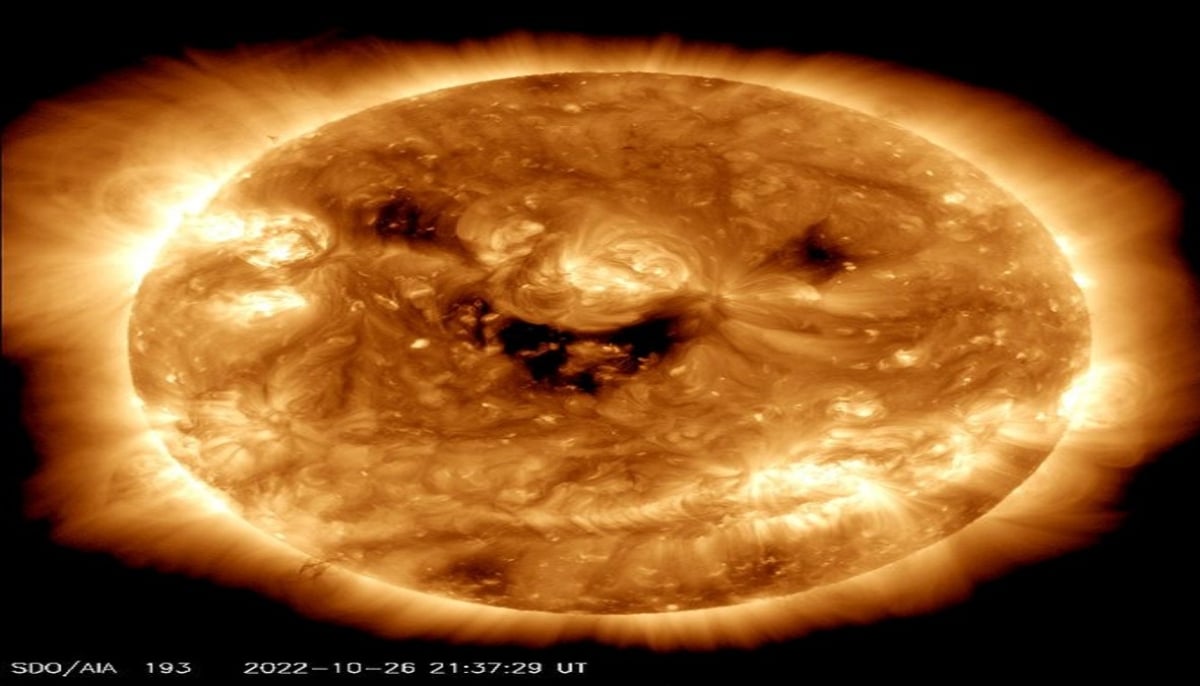
It appears that everybody who drew a happy sun as a child has been somewhat proven to be correct by science.
The largest object in our solar system appeared like the Stay Puft Marshmallow Man from Ghostbusters, the baby-faced sun from Teletubbies, or a jack-o'-lantern, in a photo taken by NASA's Solar Dynamics Observatory last week.
However, what appears to be a Scrub Daddy sponge on fire might not be as adorable as it seems.
The solar emoji might result in a stunning aurora sighting for those of us on Earth or it could indicate a problem with the planet's communications infrastructure.
Professor of physics at the University of California at San Diego Brian Keating claimed that the sun is essentially “the largest nuclear reactor in our solar system."
The enormous, spinning, incandescent ball of hot gas is a whirlwind of activity every second, from electrical storms and sunquakes to the conversion of hydrogen into helium, which emits heat equivalent to many nuclear bombs.
According to Keating, The Washington Post, some of the solar activity was captured on camera by NASA's satellite on Wednesday.
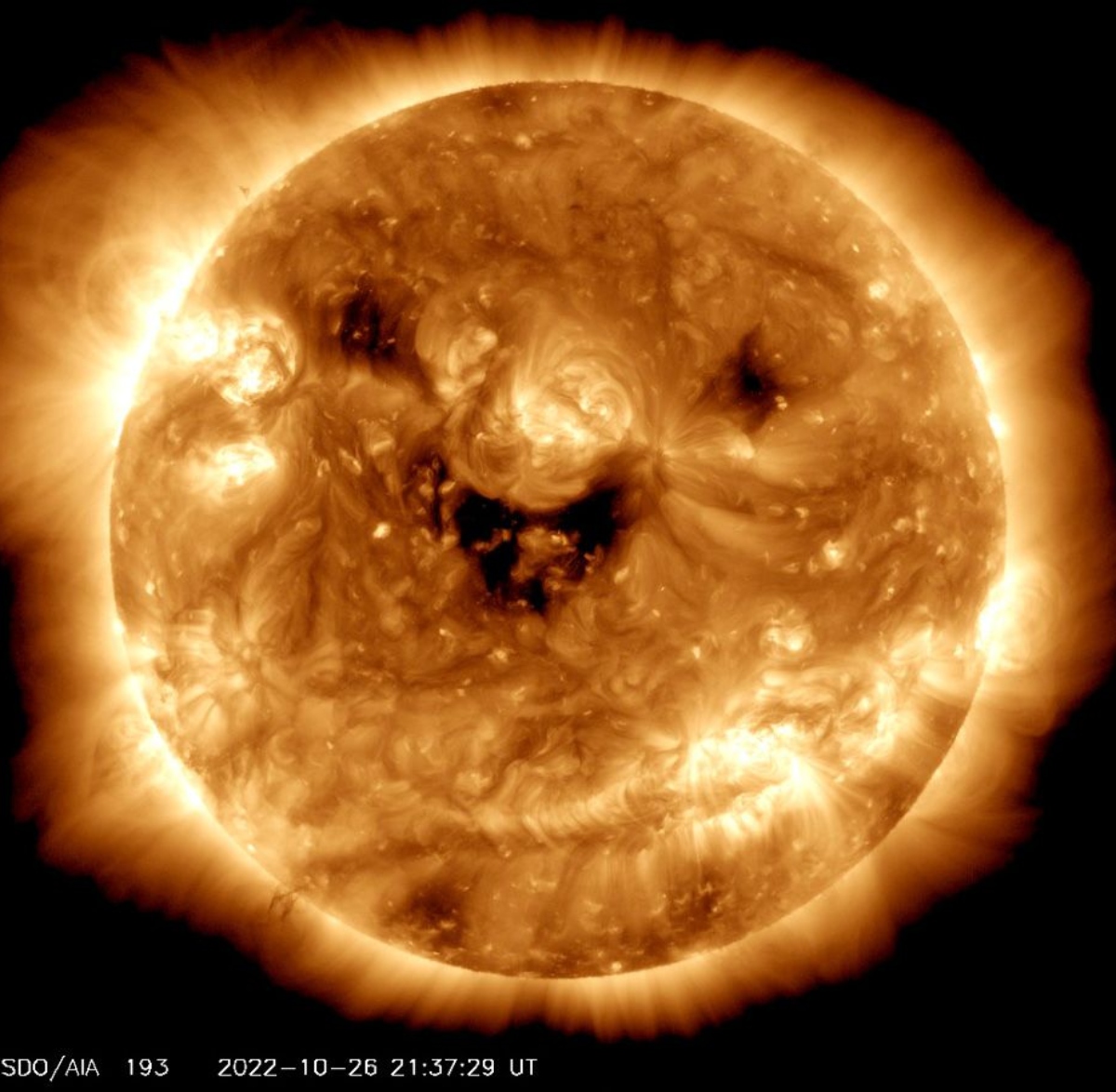
The three patches that make up the "smiling face" in the image are coronal holes, which are cooler regions of the sun's outer layer, which typically have a temperature of around 10,000 degrees Fahrenheit.
Human eyes cannot perceive these patches because they are in the ultraviolet spectrum.
"We’re talking about a few hundred degrees, so it’s not like some ski resort," Keating said. "But because they’re so dark and because we’re looking at it in ultraviolet radiation, which the naked eye can’t see, the [NASA satellite] sees them as dark holes."
It's not simply intriguing formations travelling across the sun's surface that make up the coronal holes. They are regions with strong magnetic fields that are continuously releasing solar wind, or a flow of protons, electrons, and other particles, into space.